
A professionally installed epoxy garage floor typically lasts five to ten years in Southwest Florida. UV exposure, hot tire contact, and humidity drive the wear that shortens that window. DIY epoxy kits typically fail within one to three years. Floor Shield of SWFL backs its polyaspartic garage floor coatings across Sarasota, Charlotte, and Manatee Counties with a 15-year non-prorated warranty that outlasts epoxy in this climate.
A Sarasota homeowner coats their two-car garage with a professional epoxy system and expects it to last a decade. By year three, the section closest to the garage door has turned amber. By year five, hot tire marks appear on both parking spots during summer. By year seven, the coating is peeling near the expansion joints. That timeline is common across Southwest Florida because the same conditions that make the region beautiful also accelerate the physical breakdown of standard epoxy.
What Determines Epoxy Lifespan?
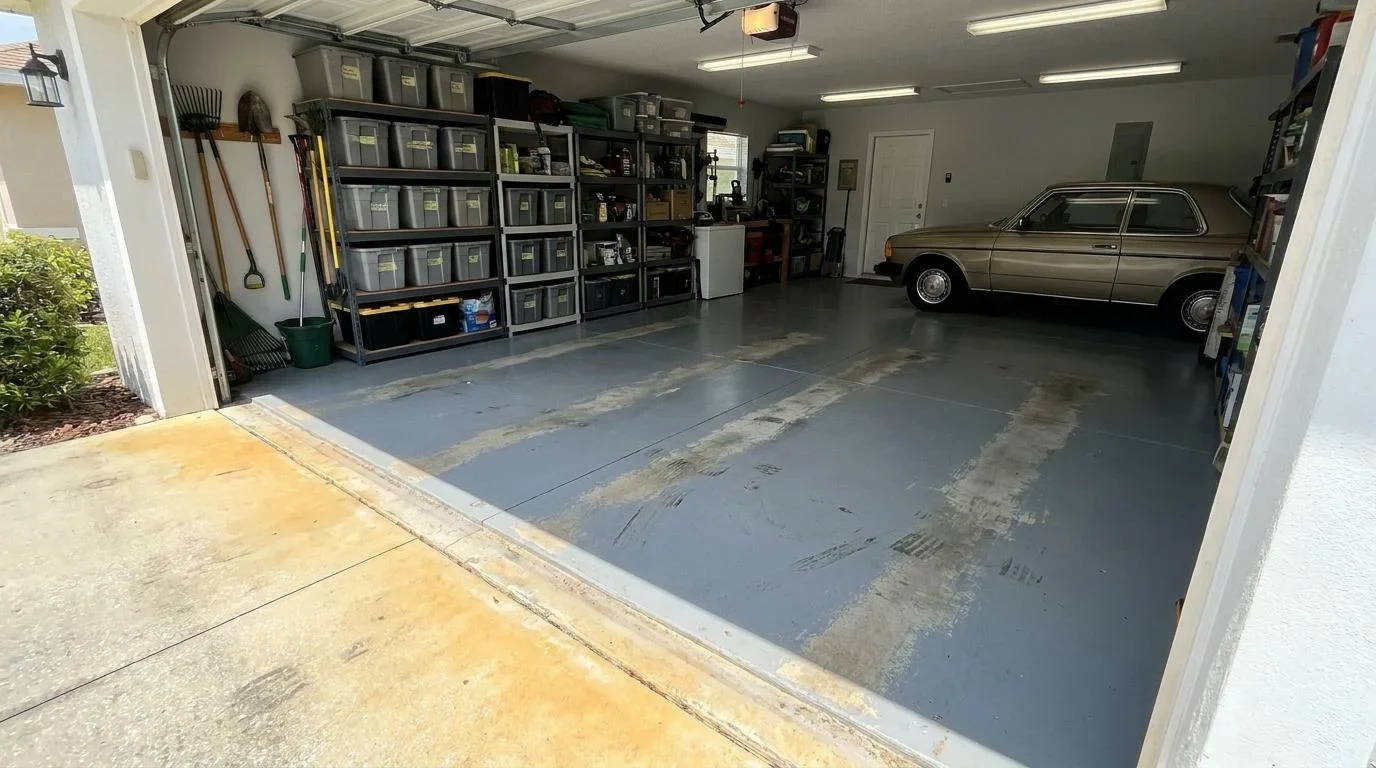
A few critical factors distinguish a lasting epoxy garage floor’s finish from a premature failure.
Installation Quality
Surface preparation is the single largest factor in how long any floor coating lasts. Professional installers diamond-grind the concrete to create a mechanical bond profile that locks the coating to the slab. Skipping this step or substituting acid etching produces a weaker bond that fails under thermal stress and moisture pressure. Most premature epoxy failures trace back to inadequate surface preparation rather than a defective coating.
Coating Thickness and System Design
A professional epoxy system applies multiple layers: a primer, one or two coats of epoxy, and a clear topcoat. Total dry film thickness typically ranges from 15 to 20 mils. DIY kits apply a single thin coat at 3 to 5 mils, which wears through faster and offers less chemical and abrasion resistance. The price difference between coating systems reflects the material volume and labor required to build a multi-layer system that lasts.
What Shortens Epoxy Lifespan in Florida
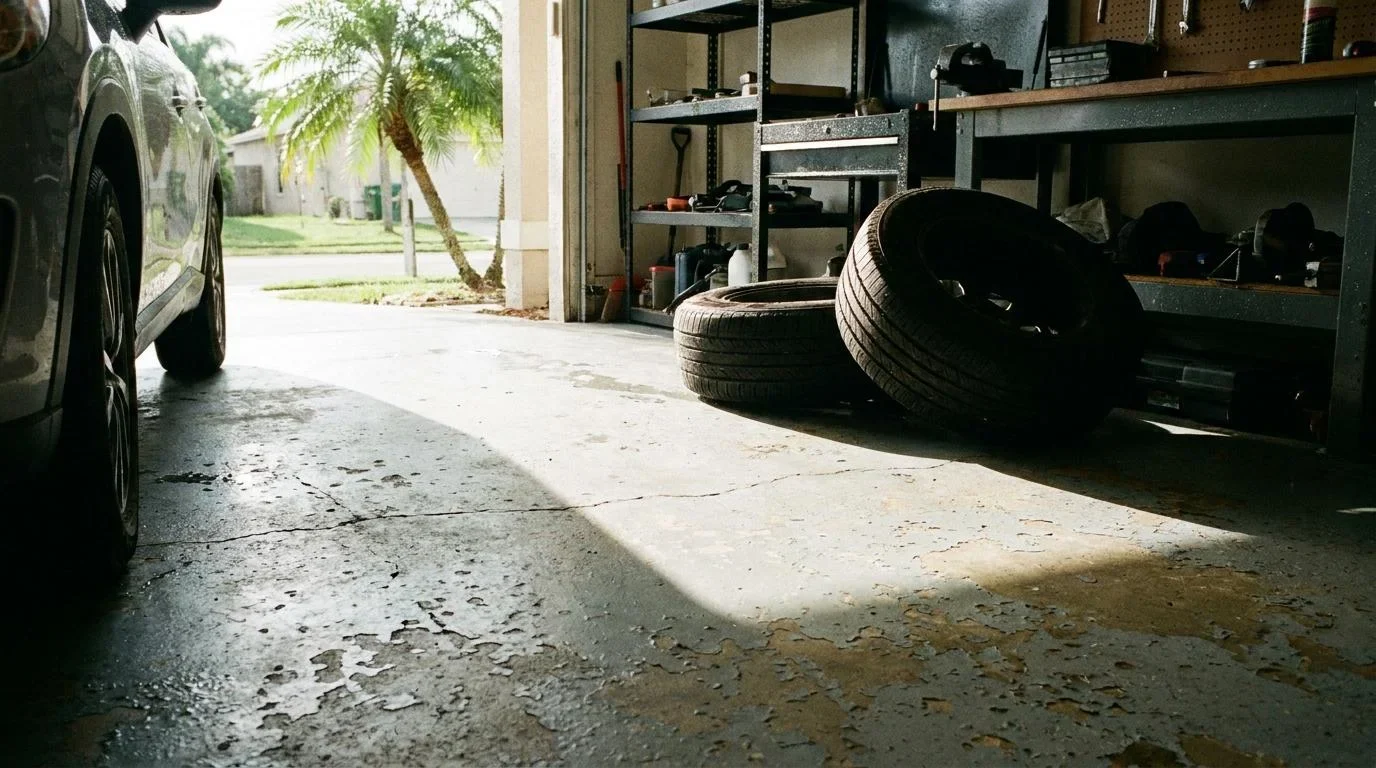
Unfortunately, the same tropical conditions that make Florida paradise are also the biggest enemies of your epoxy garage floor.
UV Degradation
Standard epoxy uses aromatic resin that absorbs ultraviolet light and breaks down through photodegradation. In Southwest Florida, where garages face direct sun through open doors for hours each day, visible yellowing from UV damage typically appears within six to twelve months near the garage opening. The discoloration is permanent and weakens the coating's structural integrity over time.
Hot Tire Pickup
Tires absorb heat from Florida road surfaces that regularly exceed 130°F in summer. That heat transfers to the epoxy when the car parks, softening the coating beneath the tire contact patch. When the car backs out, the softened epoxy pulls away with the tire. Repeated hot tire events create patchy, peeling areas that expose the concrete underneath and accelerate further deterioration.
Humidity and Moisture
Southwest Florida's water table sits close to the surface in many areas, and ambient humidity stays above 70% for much of the year. Moisture vapor migrating through the concrete slab pushes against the underside of the epoxy bond. If the coating was applied without a moisture-mitigating primer, hydrostatic pressure eventually lifts the coating away from the concrete, starting at edges, joints, and cracks.
DIY Epoxy vs. Professional Installation
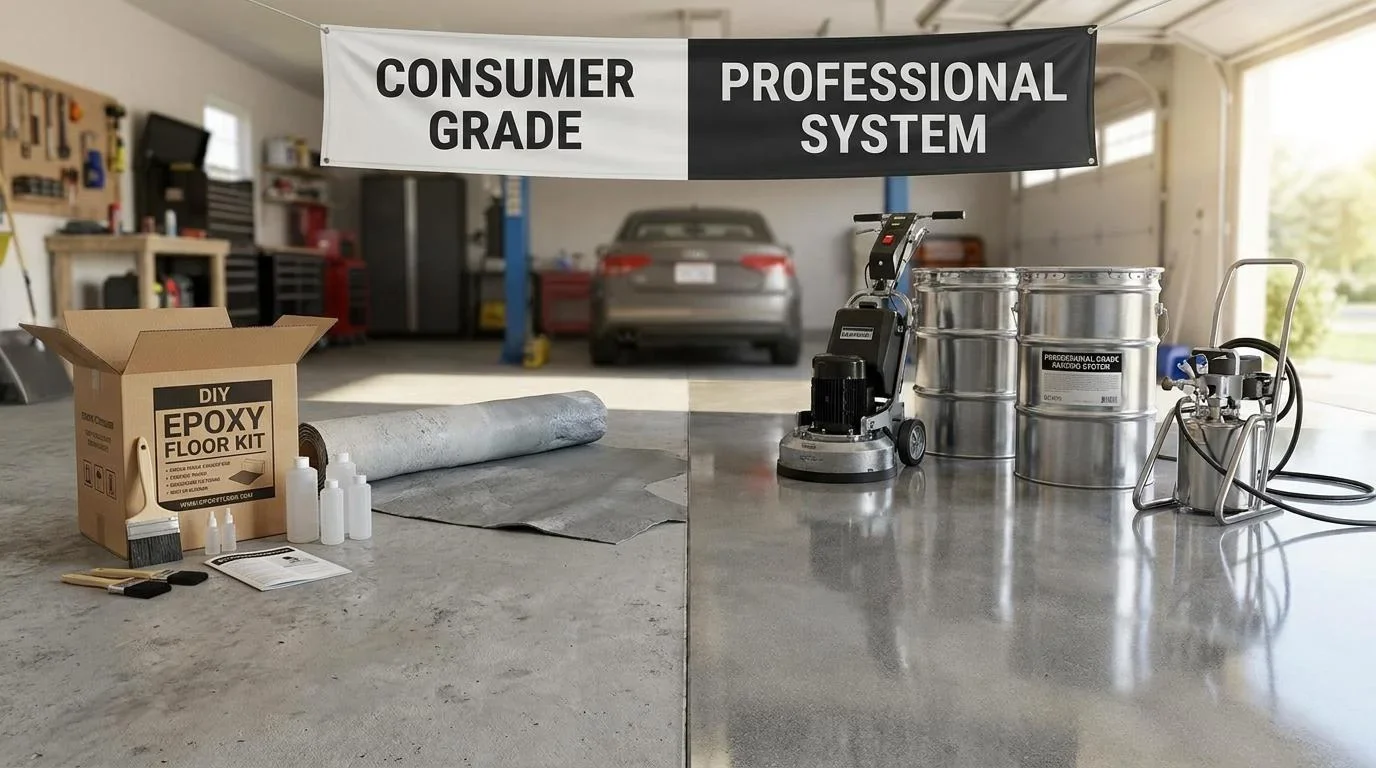
DIY epoxy kits from home improvement stores cost $50 to $300 and apply in a single thin coat over acid-etched concrete. Professional epoxy installations cost $1,350 to $3,150 for a two-car garage and include diamond grinding, primer, multiple epoxy coats, and a clear topcoat. The lifespan gap reflects those differences: one to three years for DIY versus five to ten years for professional work.
DIY kit failures across Sarasota and the surrounding communities follow the same pattern: acid-etched prep, a single thin coat, and visible peeling within one to two summers.
Frequently Asked Questions
How long does a professionally installed epoxy floor last?
A professionally installed epoxy garage floor lasts five to ten years in Southwest Florida with proper surface preparation and a multi-coat system. UV exposure, hot tire contact, and humidity shorten that range compared to northern climates where those stressors are less intense. Polyaspartic coatings installed by Floor Shield of SWFL carry a 15-year non-prorated warranty.
Why does epoxy fail faster in Florida than in other states?
Epoxy fails faster in Florida because the state combines extreme UV intensity, high road and surface temperatures, and year-round humidity. Each of those conditions attacks a specific weakness in epoxy chemistry: UV breaks down the resin, heat softens the surface under tires, and moisture undermines adhesion from below. Northern states experience these factors at lower intensity and for fewer months per year.
Is polyaspartic better than epoxy for a garage floor?
Polyaspartic is better than epoxy for a garage floor in Southwest Florida because it resists UV yellowing, does not soften under hot tires, and cures in hours regardless of humidity. Floor Shield of SWFL installs 100% polyaspartic systems that carry a 15-year non-prorated warranty, which is two to three times the expected lifespan of professional epoxy in the same conditions.
Get 15 Years From Your Floor Coating Instead of 5
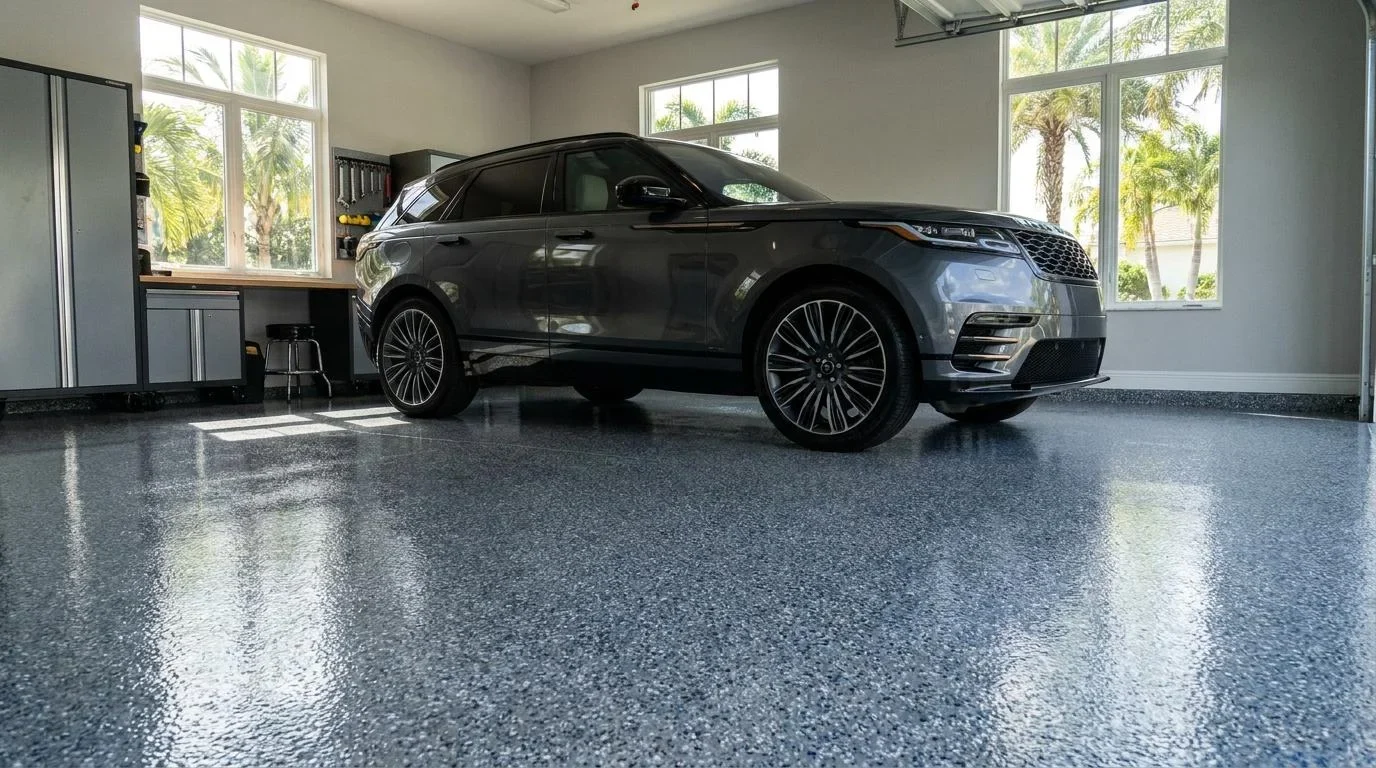
Epoxy delivers five to ten years under ideal conditions, but Southwest Florida does not offer ideal conditions for epoxy. UV, heat, and humidity work against the coating year-round, and the maintenance and recoating costs that follow erode the savings from choosing a lower-priced system. Polyaspartic handles every condition that shortens epoxy's lifespan and does it under a warranty that covers 100% of the original work through year 15.
Request a free estimate from Floor Shield of SWFL at (941) 681-8407 for a coating that matches your floor to Florida's real conditions.